
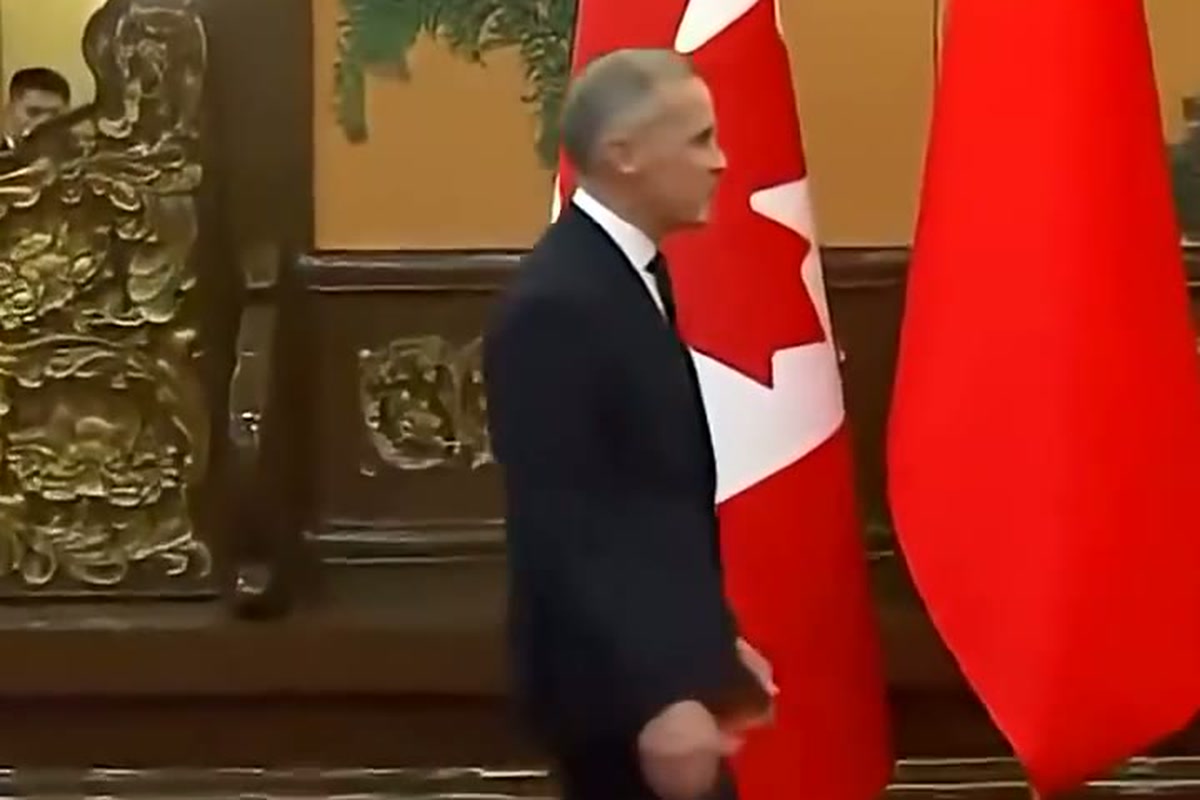
Source: CPAC, January 2026
Most people are watching this trade fight and seeing a tariff dispute between neighbors. We believe that’s the wrong lens to view this trade dispute.
On September 8th, Canada is set to impose tariffs on 700 categories of American goods: dairy, farm equipment, manufactured products, with rates reaching 50%. Prime Minister Mark Carney has called it what it is: Canada is “at war” with the United States. In a global trade environment where most countries are quietly negotiating with Washington, only two have chosen to fight back directly: China and Canada. Think about that pairing for a moment.
This is not a coincidence. And it didn’t start with tariffs.
In January 2026, Carney traveled to Beijing to meet with Chinese leader Xi Jinping. A month later, he stood at Davos and told the World Economic Forum that “the old order is not coming back.” He wasn’t talking about trade policy. He was signaling a fundamental geopolitical realignment: Canada positioning itself as a leader in a new global order, one explicitly built around alternatives to American economic dominance. Gas Outlook called it plainly: Davos 2026 was the moment Canada pivoted to China. The Beijing meeting and the Davos speech did not get nearly enough attention in the United States that they should have.
Because what followed was entirely predictable.
One of the Trump administration’s central objections to NAFTA was that Canada was being used as a backdoor into the American market, allowing countries like China to route goods through Canada and receive preferential trade treatment as if they were Canadian-origin products. NAFTA was renegotiated and replaced with USMCA specifically to close that loophole. Canada agreed to stricter origin requirements on paper. Here is the critical sticking point no one is mentioning: the USMCA contains a clause that gives any party the right to exit the agreement if another party signs a free trade deal with a non-market country. The US has formally designated China as a non-market country. In practice, any meaningful trade agreement Carney signed in Beijing could give Washington the legal basis to withdraw from USMCA entirely and renegotiate bilaterally with Canada and Mexico separately. Washington asked Canada to address the transshipping issue: enforce origin requirements, build more domestic production capacity, close the backdoor. Canada refused. Viewed through the lens of the Beijing summit and the Davos speech, that refusal looks less like a trade policy disagreement and more like a deliberate strategic choice about which economic power Canada intends to align with going forward.
At some point that stops looking like a trade dispute and starts looking like Canada picking a side.
The numbers make Canada’s position even harder to defend. Canada sends 75% of its exports to the US. The US sends 17% to Canada. Canada’s GDP is $2.1 trillion. The US economy is $27 trillion. Canada cannot win this standoff on economic terms. So why fight it? The most plausible answer is that preserving the Chinese transshipping arrangement and signaling independence from Washington is worth more to Carney politically than the cost of this trade war. That is a choice. And the US should treat it like one.
Canada’s retaliation does create real friction. Agriculture, with over $26 billion in US exports to Canada annually, concentrated in Midwest swing states. Autos, where a single vehicle crosses the border eight times during production and 50% tariffs don’t raise prices so much as break established cross-border supply chains. Energy, where Canada supplies roughly 60% of US crude oil imports. These are not random targets. They are pressure points engineered to generate political noise in Washington.
But friction is not leverage. The US holds the better hand on every dimension that matters. Canada would have a far stronger negotiating position if it closed the Chinese transshipping loophole, recommitted to the spirit of USMCA, and came to the table as a genuine ally. Instead it is standing at Davos declaring the American-led order dead, protecting China’s backdoor access to the American market, and retaliating against American farmers, autoworkers, and energy producers.
The real trade war is with China. Canada just told us whose side it’s on.
How Bankers Edge Can Help
We are not writing this from a distance. Bankers Edge Advisory is headquartered in the Detroit area, and for the past year we have been working directly with US and Canadian-domiciled companies who saw this coming. They were asking hard questions about their exposure, already stress-testing their supply chains, and proactively taking steps to move operations into the United States before the first tariff was announced. They did not wait for the headlines. They acted.
If you are a Canadian business owner, a cross-border operator, or a US company with significant Canadian supplier exposure, the window to get ahead of this is narrowing. Whether you are evaluating a US market entry or restructuring a cross-border supply chain, Bankers Edge is here to help whether that means strategic insights and consulting, or raising the capital to fund a new US-based operation. Let’s have a conversation.