
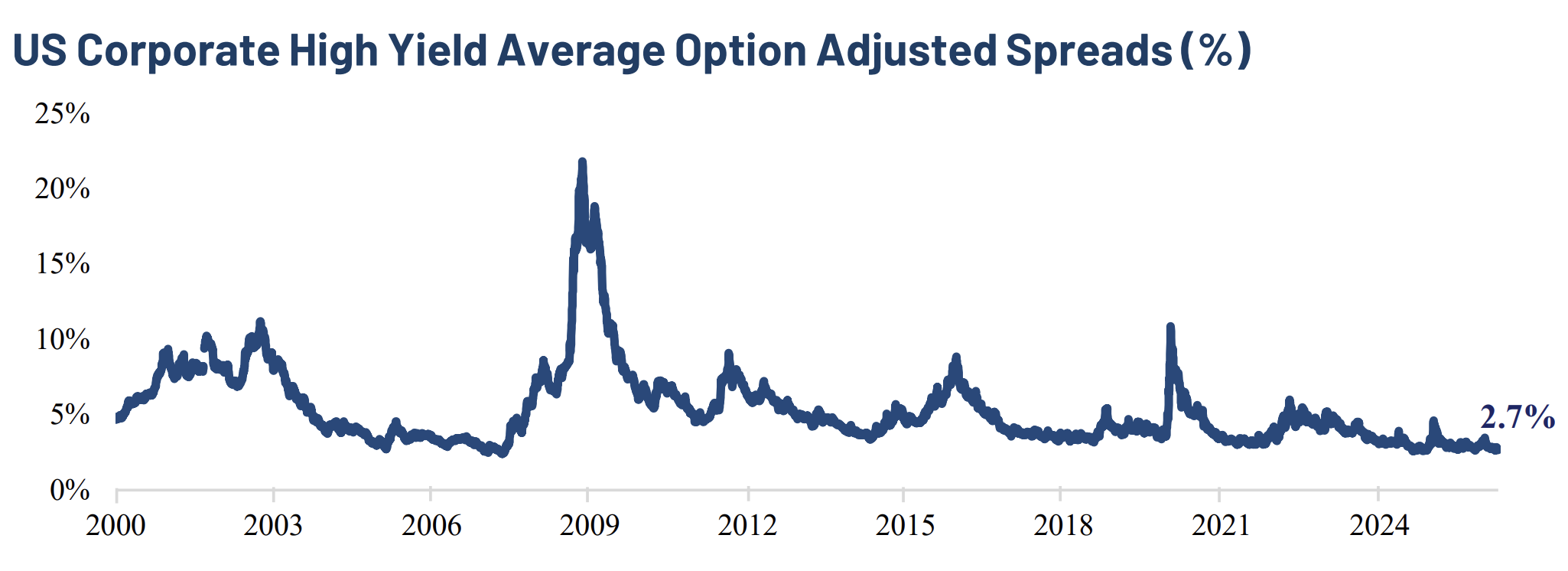
High-Yield Spreads Are Signaling More Competitive Middle Market Financing


High-yield credit spreads have compressed sharply this year, falling from a 3.16% high to a low near 2.70% in early July. That is about as low as high-yield credit risk has been priced in nearly two decades. For public issuers, that’s a market data point. For middle market companies, it’s a signal worth reading closely, because what happens at the top of the credit market rarely stays there

When spreads on below-investment-grade debt tighten this far, capital gets cheaper and lenders get hungrier. Banks, private credit funds, and direct lenders that compete for yield in the public market eventually chase it in the middle market too. Tighter spreads today often mean more available capital and more competitive terms for privately held companies in the quarters ahead

For a middle market company weighing a refinancing, acquisition, or capital raise, that’s the opening. Lower credit premiums up the chain can improve your financing economics too. But the middle market doesn’t get the index price. Your access and terms come down to your leverage, cash-flow stability, sector, collateral, and how well your credit story is told. Two companies with identical financials can get very different answers depending on how they come to market.

So don’t read a sub-3% headline and assume the door is open to everyone. It’s open to companies that know exactly where they sit on the quality spectrum and can prove it to a lender.

That’s where we come in. Bankers Edge Advisory helps middle market companies translate a favorable credit market into real terms. We position your credit story, sharpen your financing, and help you move while the window is open. If a refinancing, acquisition, or raise is on your horizon, let’s talk before conditions shift.

Source: Federal Reserve Bank of St. Louis; J.P. Morgan Domestic High Yield Index; Bankers Edge Advisory analysis.


Search Here
Categories & Tags
Recent Posts

"*" indicates required fields

Name*
Max. file size: 50 MB.
This field is for validation purposes and should be left unchanged.

Meet Mitch Vermet,

CFA, CAIA
Managing Director
Our other Managing Director, Mitch Vermet, CFA, CAIA, has a decade of experience in institutional asset management and investment banking. He has served as an integral asset within close-knit investment teams responsible for building portfolios and allocating tactical assets for over $30 billion in institutional capital.
Since earning a BA in Economics from the University of Michigan and an MA in Management from the Ross School of Business at the University of Michigan, Mr. Vermet has demonstrated mastery in helping clients manage and structure their balance sheets with strategic asset liability management solutions. He has built a reputation for helping clients strategically manage risk while capitalizing on opportunities across unique macroeconomic scenarios, lending valuable expertise and foresight to clients.  

Mr. Vermet is a member of the CFA Institute and CAIA Association. He is also a Registered Representative of BA Securities, LLC, and a member of FINRA and SIPC.

Meet Richard Consul,

CFA
Managing Director
Richard Consul, CFA, brings unmatched expertise and experience as one of our Managing Directors. Mr. Consul has over 20 years of domestic and international secondary market expertise as a Senior Portfolio Manager and Fixed Income, Currency, and Commodities Strategist.
Since earning a BBA in Finance and an MSE in Financial Engineering from the University of Michigan, Mr. Consul has served as a dedicated business partner to many corporate, banking, and insurance clients. He has built a reputation for helping clients solve and overcome various complex liquidity, risk management, ALM, and secondary market challenges. 
Mr. Consul has lent his expertise to countless financial publications and platforms, including Asset TV, a renowned video research platform for investment professionals. He is a member of the CFA Institute and has received certifications in Securities Industry Essentials (SIE), Series 82, and Series 63 through FINRA.