
America’s Structural Long Position in Oil: Rethinking the Oil-Price Shock

What if everything you learned about oil prices and the economy is wrong?

I ran some simple math this weekend and the numbers surprised me.

We’ve been taught that higher oil prices hurt American consumers. That was true – when we were a net importer of oil. But that world doesn’t exist anymore.

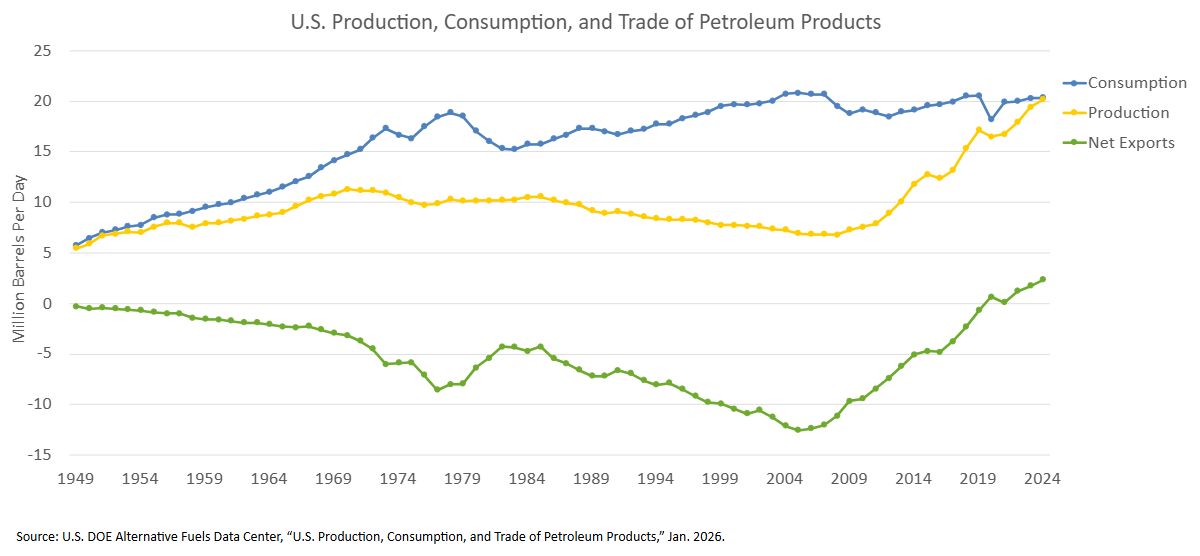
Today, the US produces 13.6 million barrels per day. We’re the world’s largest crude oil producer.

At $100/barrel, domestic production generates ~$469B in annual revenue. Total household energy spending across 130M US households? ~$437B.

Production revenue now exceeds the entire consumer energy burden by $62B – before multiplier effects from jobs, drilling, and state tax revenue.

Moreover, the money stays home. In the 2000s, oil spikes meant hundreds of billions flowing to Saudi Arabia, Venezuela and Russia. Today it recirculates locally – wages, royalties, equipment orders, state budgets.

In addition, recent tax legislation blunts whatever consumer sting remains, putting ~$2,900 back into household pockets. Those tax savings more than offset the energy cost increase so long as oil stays below $150.

The US economy now has a structural long position in oil.

So at what price does higher oil actually start to hurt America? I’d argue it’s a lot higher than most people think.

I would argue higher mortgage rates more negatively impact the US economy than higher oil prices. And unlike oil, where the US now has offsetting production gains, there’s no comparable domestic “long position” in higher rates – they’re almost purely contractionary for household and business capital formation.

Source: “U.S. Production, Consumption, and Trade of Petroleum Products” – U.S. DOE Alternative Fuels Data Center, January 2026.

Richard Consul, CFA | Mitch Vermet, CFA, CAIA

Search Here
Categories & Tags
Recent Posts

"*" indicates required fields

Name*
Max. file size: 50 MB.
This field is for validation purposes and should be left unchanged.

Meet Mitch Vermet,

CFA, CAIA
Managing Director
Our other Managing Director, Mitch Vermet, CFA, CAIA, has a decade of experience in institutional asset management and investment banking. He has served as an integral asset within close-knit investment teams responsible for building portfolios and allocating tactical assets for over $30 billion in institutional capital.
Since earning a BA in Economics from the University of Michigan and an MA in Management from the Ross School of Business at the University of Michigan, Mr. Vermet has demonstrated mastery in helping clients manage and structure their balance sheets with strategic asset liability management solutions. He has built a reputation for helping clients strategically manage risk while capitalizing on opportunities across unique macroeconomic scenarios, lending valuable expertise and foresight to clients.  

Mr. Vermet is a member of the CFA Institute and CAIA Association. He is also a Registered Representative of BA Securities, LLC, and a member of FINRA and SIPC.

Meet Richard Consul,

CFA
Managing Director
Richard Consul, CFA, brings unmatched expertise and experience as one of our Managing Directors. Mr. Consul has over 20 years of domestic and international secondary market expertise as a Senior Portfolio Manager and Fixed Income, Currency, and Commodities Strategist.
Since earning a BBA in Finance and an MSE in Financial Engineering from the University of Michigan, Mr. Consul has served as a dedicated business partner to many corporate, banking, and insurance clients. He has built a reputation for helping clients solve and overcome various complex liquidity, risk management, ALM, and secondary market challenges. 
Mr. Consul has lent his expertise to countless financial publications and platforms, including Asset TV, a renowned video research platform for investment professionals. He is a member of the CFA Institute and has received certifications in Securities Industry Essentials (SIE), Series 82, and Series 63 through FINRA.